SERVICES
Concrete Cancer Repair, Sydney.
Concrete cancer never stops on its own. The earlier it is treated, the smaller the job.
Rust stains, cracking and flaking concrete are among the most common defects on Sydney buildings, especially near the coast. They are usually signs of concrete cancer: steel reinforcement corroding inside the concrete and slowly breaking it apart from within.
Caught early, it is straightforward to put right. Left alone, it only ever grows.
As a family-run, licensed builder working on Class 2 buildings, we repair concrete cancer and spalling across Sydney for strata, commercial and residential buildings. We work to engineered scopes, treat the corroding steel and the moisture that caused it, and leave you with a documented, compliant repair that lasts. Concrete repair is part of our broader facade repair and restoration service.
Concrete cancer FAQs
Concrete cancer, also called concrete spalling, is one of the most common and least understood building defects in Sydney. Projex Pro repairs it on strata, commercial and residential buildings, and these are the questions owners corporations, strata managers and homeowners ask us most.
What is concrete cancer?
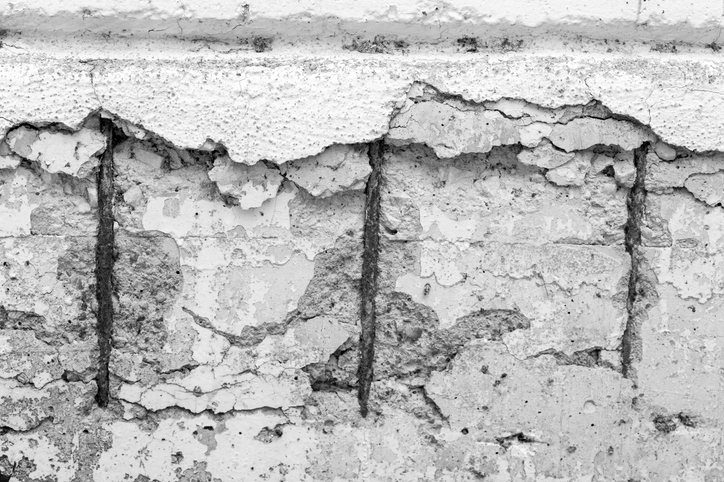
Concrete cancer is the common name for corroding steel reinforcement inside concrete. When moisture and air reach the steel it rusts, and rusting steel expands to several times its original size. That expansion cracks the surrounding concrete and pushes it off in flakes or chunks, which lets more moisture in and speeds the process up. The name fits because of how it behaves: it starts small, it spreads, and it does not stop on its own.
What are the early signs of concrete cancer?
The usual first signs are rust stains bleeding from concrete, hairline cracks running in straight lines (tracking the steel inside), bubbling or blistering paint and render, and concrete that sounds hollow or drummy when tapped. Later you may see exposed rusting reinforcement, or find fallen fragments of concrete below balconies and awnings. If any of these appear on your building, confirm the cause early. Our free Building Health Check and Defect Map are a good place to start, and an inspection will establish the extent before any repair is scoped.
Is concrete cancer dangerous?
It can be. Spalling concrete drops material from height, which is a genuine safety risk above walkways, balconies and entries, and corroding reinforcement slowly weakens the elements it sits inside, including balcony slabs and balustrade fixings. For owners corporations it is also a duty-of-care issue, because known defects that put people at risk need to be acted on. None of this means panic: it means confirm the extent, make safe anything overhead, and put a proper repair on the books.
What causes concrete cancer?
Two main processes drive it. Carbonation is the slow change in concrete chemistry from exposure to air, which strips away the natural protection concrete gives its steel. Chloride attack is salt reaching the steel, which is why coastal buildings on the Northern Beaches and in the Eastern Suburbs see so much of it. Water ingress from failed waterproofing, joints or render accelerates both, and buildings where the original construction left the steel too close to the surface are the most vulnerable of all.
How is concrete cancer repaired properly?
A lasting repair treats the steel and the cause, not just the hole. The affected concrete is broken out past the corrosion to sound material, the reinforcement is cleaned back to bright steel and treated, or replaced where too much section has been lost, and the area is reinstated with purpose-made repair mortars. A protective coating then slows carbonation across the wider surface, and the moisture path that started the corrosion, whether failed sealant, waterproofing or drainage, is closed so the same failure does not simply return. On structural elements we work to an engineered specification, so the repair is designed, not improvised.
Why does concrete cancer come back after patching?
Because a cosmetic patch treats the symptom and leaves the disease. If the corroded steel is not exposed, cleaned and treated, it keeps rusting quietly behind the new patch, and if the moisture path is not closed, the next section of steel starts corroding beside the first. This is the most common thing we see on buildings with a history of piecemeal repairs: the same spots reopening every few years. Repairing it as one engineered scope costs more than a patch on the day, and far less over the life of the building.
What does concrete cancer repair cost in Sydney?
It depends on the extent of the corrosion, the height and access, and whether structural elements are involved, which is why prices quoted sight unseen are rarely honest ones. Small, isolated spalls on an accessible wall are a modest repair; elevation-wide corrosion on an occupied strata building is a scoped project with engineering input. Our approach is to inspect first and confirm the extent, so you are pricing a defined solution rather than a guess. For strata buildings the works are typically planned against the capital works fund, and our free Capital Works Fund Check shows how prepared your building is.
Who pays for concrete cancer repairs in a strata building?
On most strata plans the concrete structure, external walls and balconies are common property, which makes the owners corporation responsible for the repair rather than individual lot owners. The strata plan and by-laws settle the detail, and your strata manager can confirm where the boundary sits for your building. We work with strata managers and committees every week, and we provide the scope, documentation and evidence a committee needs to approve works with confidence. Projex Pro Pty Ltd holds NSW contractor licence 378139C, and our director Steve Evans is a registered Class 2 building practitioner (BUP0001044), so our repairs come with the compliance records Class 2 buildings require.
Concrete and facade work we have delivered.
Combustible cladding removed, rusted steel fixings and mould treated at the source, and a new compliant facade system installed.
Water ingress traced to failed membranes and stopped at the source, closing the moisture path that drives corrosion.
Let’s stop it spreading, properly.
Book a concrete cancer inspection or speak to our team.
We’ll confirm the cause and the extent, and show you exactly what it takes to fix it properly.