Most strata committees make big remedial decisions with almost no information. The data exists, the NSW Building Commission surveys it every two years, and the rules are written down in the Design and Building Practitioners Act. But none of it is usable at 7pm on a Tuesday when a committee is staring at a damp patch photo and a quote they do not understand.
So we turned it into tools. Three of them, free, on this website, no sign-up, and nothing you enter is recorded. Here is what each one does and when to reach for it.
1. The Building Health Check: three minutes, a traffic light, and an AGM page
53% of NSW apartment buildings registered between 2016 and 2022 reported at least one serious defect, and the 2025 survey found the same rate again. The Building Health Check tells you which side of that number your building is likely on. Ten taps about the symptoms you can see, water stains, drummy render, cracking with rust, and it scores your building against the NSW pattern and hands you a printable one page summary, written to be tabled at your next AGM, with suggested wording for the minutes.
Use it when something looks off and you want to know how seriously to take it, or before an AGM when the committee needs a starting point that is not a guess.
2. The Defect Map: see where buildings actually fail
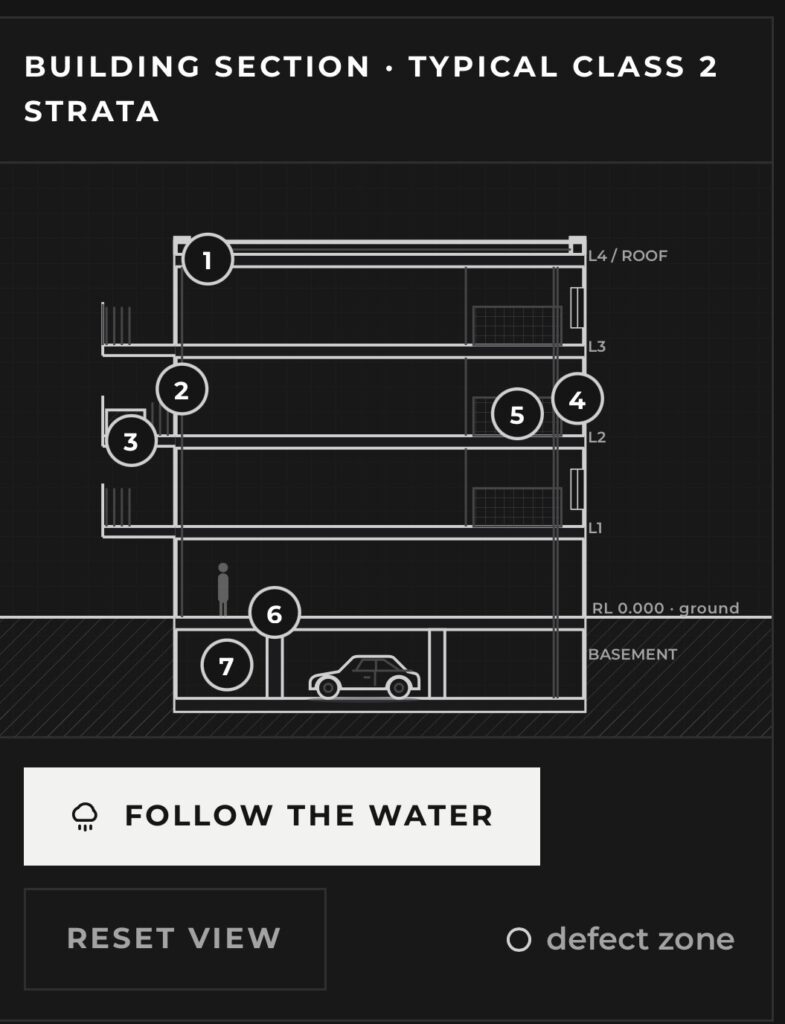
Everyone talks about defects. Nobody had drawn one. So we did. The Defect Map is a section drawing of a typical NSW strata building with the seven places buildings actually fail, ranked from the survey data. Tap a zone and you see what goes wrong there, the early warning signs and how serious it gets. Then press Follow the water and watch one storm find five ways into the same building, because five stains in five apartments are usually one weather event.
Use it to understand a leak that keeps coming back, or to show an owner why the stain on their ceiling started three floors up.
3. The DBP Check: does that repair need a registered practitioner?
Since July 2021, most remedial work on class 2 apartment buildings needs registered designs and registered practitioners, lodged on the NSW Planning Portal before work starts. Some work is excluded, emergency work runs on its own clock, and class 3 buildings join the scheme in 2028. The DBP Check walks you through six taps and shows the likely pathway for your job, so you know what to ask for before you engage anyone.
Use it before you sign anything. It is sixty seconds that can save a committee from paying for work that cannot be certified.
Why a builder gives this away
Because the alternative is worse for everyone. Buildings where problems are found late cost more to fix, cause more grief, and end in disputes. Only about a third of buildings with serious defects ever report them to the regulator, which means most buildings are carrying problems quietly. We would rather meet a building at the early signs stage than at the four failed repairs stage, and if a free tool starts that conversation sooner, it has done its job.
The tools are general guidance, not advice, and none of them replaces a professional inspection. But they will make you a better-informed client, whoever you end up engaging. Start with the Building Health Check, and if the result raises questions, we are at 1800 93 94 95.